
& PRODUCT THINKER
ALANKRIT GHOSH

I'm Alankrit, 20, based in India. I build apps, design websites, and think through GTM using AI-native workflows.



How I think about products before building them.
Solo founders hit a ceiling that isn't about ideas.
At some point, every solo founder running a real business runs out of hours before they run out of opportunities. The bottleneck isn't strategy or skill — it's the operational weight of execution. Every message drafted manually, every lead researched individually, every brand post written from scratch, every Reddit thread that could've been a client conversation but went unseen.
The traditional answer is to hire. But hiring means payroll, management overhead, and onboarding time — none of which make sense before your revenue can support it. You end up stuck: too busy to scale, too early to hire.
Core insight: The work of running a business didn't change, but the cost of automating it dropped to near-zero. What previously required 3-5 people can now be orchestrated by one person with the right agent architecture.
- →3+ hours daily lost to ops work — outreach, monitoring, context-switching
- →4 distinct operational roles a solo founder has to fill simultaneously
- →No system = the founder is always the bottleneck
Primary user: The Solo Builder-Founder
One user. One use case. Very high conviction.
AgencyOS was designed for a single user type: a solo founder running a real B2B business with genuine revenue on the line. Not a hobbyist, not a team. One person, wearing every hat.
This constraint was intentional. Designing for multiple users at this stage would introduce feature bloat and ambiguous priorities. Build for one person perfectly, then generalize.
- →Execute personalized outreach to 20+ prospects per week without writing each message from scratch
- →Maintain brand presence and content cadence without a content hire or 2 hours a day of manual work
- →Never lose context on a client, lead, or project because it's buried in an inbox
- →Surface relevant Reddit conversations where being present converts to inbound
- →Delegate operational decisions to agents so the founder focuses on product, strategy, and closing
Design principle: If the founder has to touch it more than once, it's not automated enough.
Four agents. One interface. No new software.
The core architectural decision: every agent lives inside Slack. Not a custom dashboard, not a new web app. Slack is where the founder already works, so adoption is zero-friction and the system actually gets used.
Each agent is a dedicated Slack channel with its own trigger and action surface. Shared backend: Antigravity and Claude Code for workflow orchestration, reasoning, and generation.
Pulls LinkedIn activity, company signals, and role context for a given prospect. Generates a personalized outreach message with a specific hook based on what they're actually doing — not a generic template. Routes the draft to #outreach-agent for one-click founder approval before sending.
Qualified replies per week
Time per message under 2 minutes
Reply rate stays above 8%
Monitors what the founder's ICP is discussing on Twitter and LinkedIn. Surfaces 3 content angles daily based on the founder's voice and positioning. Drafts a post for each. Founder picks one and approves — no writing required.
Posts published per week
Founder time under 10 minutes per post
Voice consistency across published content
Ingests client emails, sales calls, and DM threads in real-time. Extracts key decisions, action items, and relationship context into a structured memory layer. When the founder asks "what's the status with X," the answer is instant and accurate.
Context recall accuracy
Zero dropped-context incidents
No sensitive data exposed outside intended scope
Monitors target subreddits for posts matching the founder's ICP pain points. Ranks threads by opportunity score based on recency, engagement, and problem fit. Delivers a daily digest with the top 5 threads and a suggested response angle for each.
Inbound leads generated from Reddit presence
Relevant threads surfaced per day
No spam or low-value engagement
| Agent | North Star | 30-Day Target | Kill Condition |
|---|---|---|---|
| Outreach | Qualified replies / week | 5+ replies | Reply rate below 5% for 2 consecutive weeks |
| Brand | Posts published without manual writing | 4+ posts / week | Founder spending 20+ min editing per post |
| Context | Time to retrieve any context | Under 30 sec | Any wrong-context incident causing client friction |
| Inbound leads from comments | 2+ leads / month | Fewer than 1 relevant thread surfaced per day | |
| System | Total founder hours on ops | 3h → under 30 min | System requires more maintenance than it saves |
A 3-step review for each outreach message defeats the purpose of automation. If the founder is reviewing every word, the agent is just a template engine. Replaced with one-click approve-or-edit that preserves quality control without the overhead.
Integration complexity added 3-4 weeks to the build for marginal gain at this stage. A simple Notion database handles the same job. Will revisit when prospect volume exceeds 200/month and manual tracking breaks.
Explored voice-to-agent commands via Whisper API. Found that async text in Slack is faster and less error-prone for the actual use case. Voice adds friction, not removes it.
Making agents aware of each other's output sounds powerful but creates debugging complexity unmanageable for a solo builder. Agents operate independently in v1. Shared memory is a v2 decision once each agent is stable on its own.
Building dashboards before the system is stable is polishing before shipping. Metrics tracked manually in a Notion table until output is consistent enough to justify building the tracking layer.
If AgencyOS recovers 2+ hours daily with no drop in output quality, the architecture is validated. The v2 question is whether this can be packaged for other solo founders to deploy without technical setup. That's a separate PRD.
Consistent content is a distribution strategy. Inconsistent content is noise.
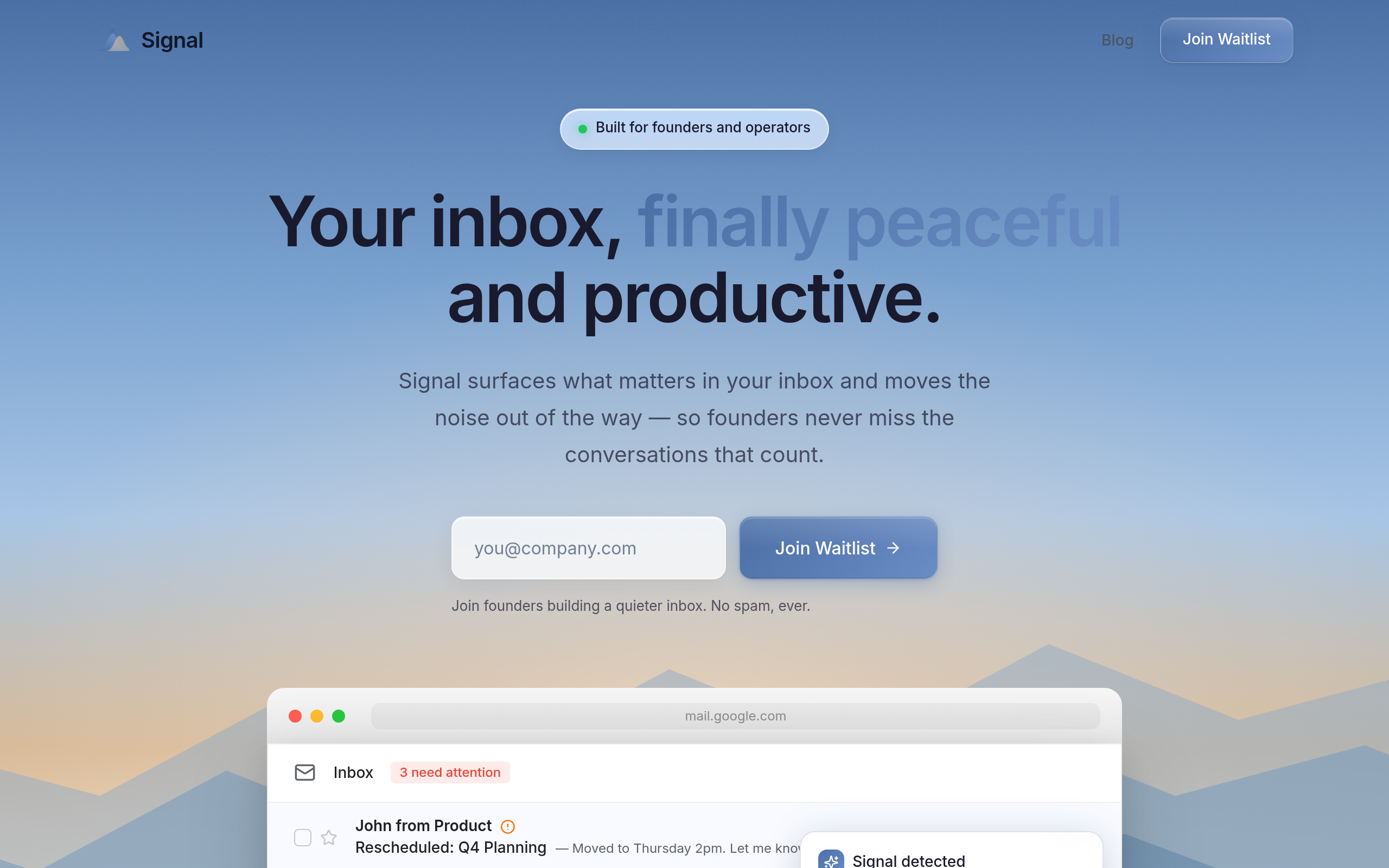
For a solo founder running two products simultaneously, a macOS app in beta and a B2B services business, content isn't optional. It's how Signal builds waitlist momentum and how LeadFlow Lab generates inbound without paid ads. But content for two distinct products, on two platforms, requires two distinct voices, two posting cadences, and a constant supply of ideas that are actually grounded in what the products do.
The manual workflow breaks fast. Ideas get jotted in Notes, half-developed, and abandoned. Drafts sit in Google Docs never getting posted. The gap between "I should post more" and actually posting is almost always the same thing: the friction of starting from a blank page.
- →Generating ideas that are on-brand and product-relevant, not generic "founder content"
- →Moving from a raw idea to a publishable draft without switching between 4 tools
- →Knowing when content is scheduled without keeping a separate calendar
- →Maintaining platform-specific constraints (Twitter character limits, LinkedIn tone) automatically
Core insight: The bottleneck isn't creativity. It's the gap between having an idea and having a published post. Every extra step in that gap is a post that doesn't get written.
Primary user: Solo founder managing content for two products
ContentFlow was built for a specific, narrow use case: one founder, two products (Signal and LeadFlow Lab), two platforms (Twitter/X and LinkedIn), needing to maintain consistent output without a content hire.
This narrow scope was the right call. A tool built for "any creator" would've been generic. A tool built for this exact situation could make opinionated defaults: pre-loaded content pillars, platform constraints baked in, voice guidelines configured once and applied everywhere.
- →Generate a week's worth of content ideas in one session, not one at a time
- →Take any idea from rough concept to platform-ready draft in under 5 minutes
- →Schedule content to Google Calendar without leaving the tool
- →Refine drafts with AI assistance when the first version isn't right
- →See all content (ideas, drafts, scheduled, published) in one place
Design principle: The tool should feel like a writing partner, not a form to fill out. Ideas go in, polished drafts come out.
Two-step generation pipeline. One dashboard. Calendar-native scheduling.
The core product decision was the two-step generation flow: ideas first, then full content. This mirrors how good content actually gets made. You diverge broadly on angles before committing to a specific execution. Skipping straight to a full draft produces generic output. Generating ideas first lets the founder pick the angle that feels right, then develop it fully.
↓
Idea generation (5-10 angles)
↓
Founder selects one
↓
Full content development
↓
AI refinement loop (optional)
↓
Schedule to Google Calendar
Model selection is intelligent, not manual. Different tasks get routed to different free models via OpenRouter based on what each model handles well. Idea generation, long-form drafting, and short-form refinement are distinct tasks with distinct optimal models. The founder never chooses a model; the system picks.
Takes a topic, product context, and content pillars as input. Returns 5-10 distinct angles, not variations of the same idea, but genuinely different framings. Grounded in Signal and LeadFlow Lab's actual positioning so ideas are relevant, not generic.
Takes a selected idea and expands it into a platform-ready draft. Applies platform constraints automatically: Twitter character limits, LinkedIn's longer-form structure, appropriate tone for each. No manual reformatting.
Post-generation editing loop. If the draft isn't right, the founder describes what to change and the model refines it. Preserves the original and shows the delta so the founder can compare and choose.
Schedules approved content directly to Google Calendar. The posting schedule becomes visible in the same calendar the founder already uses. No separate scheduling tool, no copy-pasting publish times.
Single view of all content across states: ideas, in-draft, scheduled, published. Prevents the common failure mode of drafts sitting in limbo with no clear status.
| Feature | North Star | Target | Kill Condition |
|---|---|---|---|
| Idea Generation | Ideas founder actually develops | 3+ developed per session | Founder ignores all generated ideas and writes their own |
| Content Development | Time from idea to ready-to-post draft | Under 5 minutes | Draft requires more editing than writing from scratch |
| Refinement Loop | Rounds of refinement per post | Under 2 rounds average | Posts require 4+ rounds before founder approves |
| Scheduling | Posts actually scheduled via tool | 80%+ of drafted content | Founder copies drafts to a separate scheduler |
| System | Posts published per week | 4+ across both products | Posting frequency doesn't improve vs. manual workflow |
Tracking which posts perform well and feeding that back into future generation is the obvious v2 feature. Cut from v1 because it requires a published content history to be meaningful. You can't optimize distribution data you don't have yet. Build the creation habit first, optimize based on data second.
Multi-user access, comment threads, approval workflows: none of this was relevant for a solo-founder internal tool. Adding it would have doubled the complexity for zero benefit to the actual user.
The Twitter and LinkedIn APIs would allow fully autonomous posting. Cut deliberately. Content that goes live without human review is a brand risk. The scheduling step, draft, approve, then post at a scheduled time, preserves a final check without adding friction. Full automation is a trust problem, not a capability problem.
Repurposing a LinkedIn post into a Twitter thread, or a thread into a short-form video script, is genuinely useful. Cut because it's a separate generation problem requiring its own prompt engineering and quality bar. Scope creep disguised as a feature.
ContentFlow works. The generation pipeline produces usable output, the calendar integration functions, and the dashboard gives clear visibility on content state. The tool itself isn't the problem.
It was shelved for a simpler reason: the workflow it was built for changed. As AgencyOS came together and the Brand Agent took over content ideation, ContentFlow's job was absorbed into a system that operates inside Slack with less friction. Running a separate web app for content when the Brand Agent already drafts inside the founder's primary work surface made ContentFlow redundant, not broken.
- →The two-step idea-then-develop pipeline is genuinely the right model for AI content generation. The quality difference between "generate a post about X" and "generate 8 angles on X, pick one, then develop it" is significant and measurable. That insight directly informed how the Brand Agent in AgencyOS was designed.
- →The free-model routing via OpenRouter also validated that content generation doesn't require expensive models. Gemma 2 and Qwen produce output that's indistinguishable from GPT-4 for this specific task. Model selection should always be task-matched, not defaulted to the most powerful option.
If this were ever productized: ContentFlow's real value isn't the generation, it's the opinionated defaults. Pre-loaded content pillars, platform constraints, voice guidelines configured once. That setup is the moat. If it were rebuilt as a product, onboarding a founder's brand voice and product context in the first session would be the core experience, not the generation UI.
- Framework: Next.js 14 (App Router)
- Database: Neon Postgres
- AI: OpenRouter (Gemma 2, Qwen, Mistral, free tier)
- Calendar: Google Calendar API
- Auth: Google OAuth
- Styling: Tailwind CSS
- Deployment: Vercel
I think through positioning and go-to-market before writing code.
- Analyzed 50+ manufacturing companies
- Discovered buyers were management, not workers
- Repositioned from "worker tools" to "management ROI dashboards"
- Changed entire messaging from "help your workers" to "10x your visibility"
- Created framework covering hiring, funding, growth, tech stack, pain, and timing signals
- Applied to 100+ prospects for LeadFlow Lab outreach campaigns
- Documented process for repeatability
I use AI tools to ship 10x faster than traditional development.
I'm AI-native. I use Claude and Cursor to increase output without sacrificing quality. This lets me ship MVPs in days instead of weeks, iterate based on real feedback, and focus on product decisions rather than boilerplate.
I'm not the strongest traditional engineer, but I ship faster than most teams. For early-stage where speed matters more than perfect code, this is an advantage.
What I'm optimizing my career for.
Building an AI product that solves a real-world problem. One that pushes humanity forward, not just metrics.

Working alongside YC founders and builders making a real mark. Learning what can't be taught in tutorials.

Building a product used by 10,000+ people.
Paying off student loans in year one. Financially free by 22.

Driving through the Alps. A summer in southern Italy. Road-tripping LAX to NYC. A week in Spain. Living in Manhattan. Not running from work. Running toward a life worth building for.
A week in a monastery. Trekking across Himachal. Building requires knowing when to stop.

Building a personal brand and a company brand. Thought leadership, product, content, all of it.
Somewhere between SF and Bangalore. Shipping code that crosses timezones.
I'm looking for my first product role at a US-based YC startup.
Open to: Product roles, GTM roles, operations, or 'first hire' positions at early-stage companies
Available: Part-time now, full-time April 1st, 2026
Optimizing for: Learning from experienced founders + strong compensation to clear student loans quickly
I respond fast. Usually within a few hours.